Tuesday, April 6, 2010

Astonished

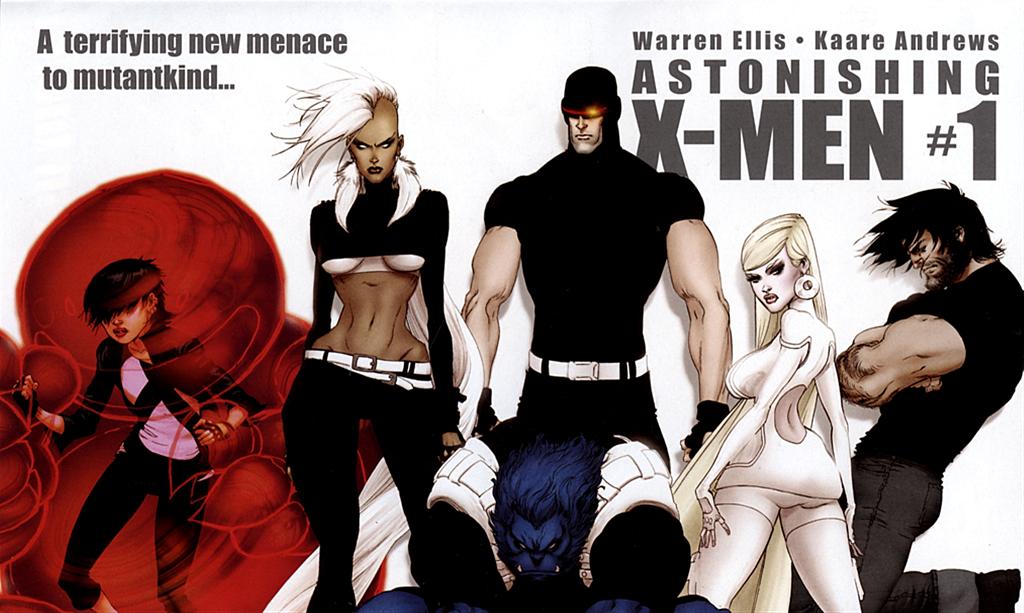
The March 2010 solicit in Marvel Previews for Astonishing X-Men #1 caught a bit of amusing flack on Twitter and the interwebs for its depiction of Storm and Emma Frost. Presenting the Queen of Wakanda desperately in need of a sandwich and in an outfit that doesn’t even cover her bra, and the former White Queen’s lumpy ass seemed enough to justify the barbs.

But that really didn't do anything to deaden my surprise when I opened this month's Marvel Previews and saw the issue #2 solicit. In a pose that appears to owe as much to pornography as it does anything else, we get a shot of Emma’s over-inflated bosom dripping with fresh mutant-baby spit-up!

I respect all visual artists because they possess a talent beyond my capabilities, but that doesn’t mean I’m going to like everything they do. I really dug Kaare Andrews' Immortal Iron Fist and Dead of Night Featuring Man-Thing covers. Although his Astonishing X-Men work might be spectacular and right up someone else’s alley, the preview images are striking all the wrong notes with me.

Monday, April 5, 2010

Marvel Unbound - Spider-Man: Death of the Stacys

There are just two characters left in the Marvel Universe whose death you don’t mess with: Uncle Ben and Gwen Stacy. (Bucky Barnes used to be in that group until Ed Brubaker’s masterful resurrection and reintegration of the character on the pages of Captain America.) I know the story of how Gwen Stacy died, but had not actually read the two-issue arc that took her from Peter Parker and secured her place in the Spider-Man mythos until now.

Outside of Peter’s blood relatives (i.e., Uncle Ben and Aunt May), the Stacys has to be the family most devastated by their relationship with Peter, losing both a father and a daughter because of their involvement with the Webslinger. The Spider-Man: Death of the Stacys Premier Hardcover presents chronologically Amazing Spider-Man issues #88-92, and issues #121-122. The first five issues contain the death of Gwen’s father, Police Captain George Stacy, the last two issues the death of Gwen.


The setu
p for Captain Stacy’s end is wonderfully subtle as the opening three-issues unfold effortlessly. Spidey’s multiple battles with Doctor Octopus are interspersed with glimpses into Peter’s relationship with both Captain Stacy and Gwen. After Captain Stacy’s honorable death indirectly at the hands of Doc Ock, we watch Gwen and Peter deal with the loss and witness Gwen misplace blame for her father’s death with Spider-Man.

As nuanced as this story is, it also struck me how similar the Gwen/Peter/Spider-Man dynamic is to the Harry Osborn/Peter/Spider-Man dynamic in the 2002 Spider-Man movie: the holding of Spider-Man responsible for the death of Captain Stacy/Norman Osborn by their offspring Gwen/Harry, who is in a relationship/close friends with Peter. That is not to diminish storytelling of either body of work; if anything it’s a testament to how time-honored the comic book’s premise is, and how well-translated that was by the movie’s screenwriters.

The story is continued on the pages of the next couple of issues (also collected here) with a political corruption plotline that paints Gwen into a weak, naïve position in its attempts to illustrate just how distraught
Gwen is over her belief that Spider-Man killed her father. Even J. Jonah Jameson has more dynamic character growth over these couple of issues than the easily manipulated Gwen. I get why you continue the story (how could you ignore it?!), but the handling of Gwen feels clumsy at best.

Where the story of Captain Stacy is spread over five issues and given room to breathe, the story of Gwen’s death and its immediate aftermath are a study in concise narration, with not a single panel or word wasted. The weight heaped on issues #121 and #122 is staggering. These two 1973 issues have shaped Peter Parker’s world, the Marvel Universe, and comics as a medium.


Gerry Conway’s storytelling is economical, moving the story swiftly but with impact from beginning to end. On these 40 or so pages we witness the madman’s reemergence in Norman Osborn, the raw anguish in Spider-Man, and the beginning of the evolution of Mary Jane Watson from party girl to more mature young adult.


As stunning as “The Night Gwen Stacy Died” is, “The Green Goblin’s Last Stand” is every bit as shocking in its portrayal of Peter’s reaction to Gwen’s death. Spider-Man brutally attacks the Green Goblin, exacting a vengeance on his archnemesis usually reserved for the likes of Punisher. Every ounce of pain is squeezed from Peter over three pages of a vicious fight, ending in the same inadvertent death-by-his-own-hand that the Green Goblin experienced in Spider-Man movie. (Of course, Norman’s death in the Marvel Universe didn’t quite stick the way Gwen’s did.)

There are some misses in the lettering – words omitted, etc. – but I’m not sure if that’s a problem with the reprinting process, the original comics, or as it was intended. The art, on the other hand, is faultless. The use of montages throughout these seven issues by Gil Kane and John Romita, Sr. are pitch-perfect. While they are used enough to be noticed over the course of these books, they fit flawlessly with the tone of both the stories and era they are representative of, and colors pop off the page.


There is no sentimentality over the death of Gwen on Conway’s part. His introduction from 2007 is fairly coarse. He takes credit, by way of penning Gwen’s death, for emboldening Jim Starlin to kill Captain Marvel and Chris Claremont to create Dark Phoenix. He comes right out and admits he never liked Gwen, found her boring, and really just wanted to write about Mary Jane. It sets a terrible tone for the collection, and I would have much rather seen this as an afterword. I think Marvel editor Ralph Macchio’s 1999 essay “I Remember Gwen,” presented here as one of two afterwords, would have been much more fitting as the introduction of the collection. The other afterword is by artist Romita, Sr., along with his original character design for Captain Stacy.


Reprints of the Todd McFarlane covers of Marvel Tales Featuring Classic Spider-Man from the late ’90s that presented the Captain Stacy arc, the double-sized Gwen Stacy epic Marvel Tales reprint, and the cover art from the various previous collected editions round out the extras.


I understand the implications of Gwen’s death and have read stories supplementing these events long before I read Spider-Man: Death of the Stacys Premier Hardcover. A few years ago I was dazzled by Kurt Busiek and Alex Ross' Marvels and was moved by Jeph Loeb and Tim Sale’s Spider-Man: Blue earlier this year, both of which deal directly with the tragedy in part or as a whole. But it’s something else entirely to read the actual event as it unfolded across the pages of Amazing Spider-Man nearly 40 years ago.

Saturday, April 3, 2010

Completing the Trifecta

Henry Rollins
01 April 2010: The Kent Stage, Kent, Ohio


Tracy and I embarked on a mid-week “Three Shows in Three Nights” marathon. We didn’t plan it this way, and we didn’t originally set out to prove we can still live the life we did twenty years ago, but that’s how it ended up. And we were treated to an amusing exercise while experiencing unique acts at completely different venues.

You gotta love college town concert spots. Sticky floors, uncomfortable seats, overpriced beer, barely functioning bathrooms, and the smell of stale beer hanging in the air. That’s pretty much what we got at the last show in our whirlwind week when we saw Henry Rollins at the Kent Stage. But the atmosphere felt as appropriate as ever. (The last time Rollins came through town a few years ago he played Thursday’s, the Akron punk bar Tracy and I frequented and loved in the late ’80s.)


Taking the stage in a dark t-shirt and pants shortly after 8:00, Rollins was unstoppable for almost three hours. Covering everything from politics to travel to religion to Hollywood, he never stopped to take a break or even a sip of water.


We’re all getting old. Henry Rollins referenced his age repeatedly throughout the night. He’s got 10 years on me, but he looks fit and ready to go at a moment’s notice despite his gray. His body might say “aging tattooed punk elder statesman,” but as soon as he opens his mouth all you see is an intelligent, left-leaning, skilled public speaker.


Opening with the Mississippi high school prom canceled by the school because a lesbian student wanted to attend with her girlfriend, Rollins moved seamlessly from topic to topic. He recounted his thwarted attempts to see Ann Coulter speak in Canada last month, as well as extolling his love of the U.S. Constitution. Rollins walked the audience through how he spent Election Day 2008 in Washington, D.C., which included taking in an afternoon Bad Brains show in the hometown he shares with them.

Rollins spoke of Hollywood (his run on Sons of Anarchy and a guest-judging stint on RuPaul’s Drag Race TV show) and about his commencement speech at Sonoma College in northern California. But more than anything else, Rollins represented himself as a lonely man who lives to tour. It was kind of sad – but that was all me projecting because he certainly didn’t portray it in any feel-sorry-for-the-guy kind of way.


It was an amazing, thought-provoking show. Rollins inspires the audience to be more involved, to be better citizens of the world, to travel as much as possible, to respect each other – even celebrate our differences. The bulk of the audience was probably college-aged and probably firmly already in his camp, but it’s still good for young people to hear what Rollins is preaching (though he’d certainly never characterize what he does in that way).


On a related side note: We had dinner at the Wine Bar at Solaire before the show, and when our waiter found out we were going to the Rollins show, he told us he had wanted to go but knew he would have to work that night. Tracy and I chuckled at having such hip waiters two nights in a row.

Friday, April 2, 2010

Whatever Happened to My Rock ‘n’ Roll

Black Rebel Motorcycle Club
31 March 2010: House of Blues, Cleveland, Ohio


I have wanted to see Black Rebel Motorcycle Club since discovering them when their original self-released album was redistributed by Virgin in 2001. At one point, I was supposed to cover one of their shows for PopMatters, but something came up (I honestly don’t rem
ember if it was the band cancelling the show or something that kept me from attending) and that didn’t materialize. In the years since, stars have never properly aligned. Until now.

The evening started out with an early dinner in Akron. We told the waiter we were headed to a show when we asked for the check. He asked us which one, a
nd when we told him B.R.M.C., he said he saw them the night before in Columbus and that it was an awesome show! Tracy and I sort of laughed on the drive up to Cleveland about the odds of having a server who saw the same band the night before in another town – a server we probably had a good 15 years on, no less.

Between the packed East 4th Street district, a home Cavs game, and the B.R.M.C. show, Downtown Cleveland was hopping for a Wednesday night. Traffic – both foot and car – was heavy, but the atmosphere was fueled by the gorgeous spring weather.


Because it was a general admission show, we wanted to get there early enough to snag some seats at the House of Blues, and we were among the first into the hall. We headed to the upstairs balcony to see what was available, and asked one of the security guards if the barstools lining the back of the balcony seating were reserved or not. (Typically, the lower level is GA standing room only with some open barstool seating, the balcony itself is reserved seating, and behind the balcony is barstools and more GA standing room only. We have attended shows where those barstools are held for guests of the band and press – and have taken advantage of those seats during my PopMatters days when covering shows.) The security guy told us all the seats were open, and we did a double-take and reconfirmed with him that he meant not just the barstools, but the entire balcony. Armed with that revelation, we promptly took up residence in the front row, stage right overstuffed and comfy balcony seats for the remainder of the night.


So we totally scored on the tickets (which were buy one, get one), and on the seats… all that was left now was to be entertained.


Opener Alberta Cross made their way through a half-hour or so set looking a bit like a poor man’s Lynard Skynard. The English five-piece’s up-tempo songs (the one-two set-closers in particular) were an enjoyable enough diversion as the theater filled up.


Around a quarter after nine, Peter Hayes, Robert Levon Been, and Leah Shapiro walked on stage and began a blistering two-hour set that defied both conventional concert theatrics and staged chatty banter in favor of a straight-ahead rock and roll show. And that’s really the best way to describe the trio: They ooze rock and roll, embodying everything cool and brooding and dangerous and old school about rock, looking and sounding like some kind of twisted garage mash-up of Johnny Cash and The Jesus and Mary Chain.


Founding members Hayes and Been share vocal duties throughout their catalog, adding a layer of complexity to the compositions and increasing the wall of sound size of their output. Hayes’ guitar and harmonica work is a loud, full Americana style while he channels The Man in Black. And Been’s rangy bass playing veers between neo-psychedelic and shoegaze; he’s got the brooding rock star look down pat with his leather jacket and Ian McCulloch hair. Combined with Shapiro’s metronome drumming, they are a muscular trio.


Debut album cuts like “Love Burns”, “Red Eyes and Tears”, “Spread Your Love”, and “Whatever Happened to My Rock ‘n’ Roll (Punk Song)” stood out in the set alongside newer selections from Beat the Devil’s Tattoo, with the title track and “Bad Blood” among those highlights.


B.R.M.C. are cool. Plain and simple. Impeccable pedigrees notwithstanding – Hayes was a member of The Brian Jonestown Massacre, Been is the son of The Call’s Michael Been, and Shapiro was the touring drummer for The Ravonettes – the trio come out and rock hard, exhausting the audience. They reminded me of The Black Keys in that way.


I have waited nearly ten years to witness B.R.M.C.’s feedback-drenched wall of fuzz garage rock sound in person. Watching them on stage, I kept thinking that this was exactly the kind of band I would have loved when I was nineteen or twenty. The sound, the image, the show. B.R.M.C. are the complete package. And their show reignited that rush of youth and music and the power to be moved. Like with The Black Keys, Tracy and I will now make a point to see them every time they come through town.

Thursday, April 1, 2010

Orchestral Maneuvers

Pink Martini, with the Cleveland Orchestra (Conducted by James Feddeck)
30 March 2010: Severance Hall, Cleveland, Ohio


“Pink Martini is a rollicking around-the-world musical adventure… If the United Nations had a house band in 1962, hopefully we’d be that band.”
– Thomas Lauderdale, bandleader/pianist

When we first discovered Pink Martini, I assumed we would never have the opportunity to see this quirky music collective from Portland, Oregon live. But for the third time in six-and-a-half years, we have been fortunate enough to witness the “little orchestra” in person, every venue different, every time offering something new.

The first time we saw them, it was around the time their second album, Hang on Little Tomato, was released. The venue was the Cleveland Museum of Art auditorium, and it was spectacular. The acoustics were the best of any venue we’ve seen them in, and it was the only time we’ve seen them play “Que Sera Sera” live, with its revelatory swirling calliope-from-hell menace. Pure genius.


The second show was at the Cleveland House of Blues. They were touring behind their third album, Hey Eugene! We attended with friends and had an opera box to ourselves. It was a perfect setting in the sense of being able to cut a little loose and dance and move with the music.


Now, Pink Martini is doing an orchestra tour behind Splendor in the Grass, with a stop at venerated Severance Hall and backed by the Cleveland Orchestra. The venue was visually impressive, and the orchestra’s acoustics (both Pink Martini and the Cleveland Orchestra) were fantastic, but the vocals were set way down low in the mix, making it hard to hear lyrics and between song banter at times.


The show opened with one of my all-time favorite Pink Martini tunes, “Bolero”. In this setting, with the full Orchestra backing them, it was transcendent. This commanding instrumental was followed by singer China Forbes’ entrance, and continued an impeccable song selection that pulled from all four albums, hitting nearly every high-point necessary to make the night special. There was the traditional Turkish “Uskudar” (made famous by Eartha Kitt in the ’50s), the playful one-two of “And Then You’re Gone”/“But Now I’m Back” from Splendor in the Grass. “Sympathique” and “Donde Estas, Yolanda?”, both from their debut, also showed up in the first set.


The second set opened with one of Tracy’s all-time favorites, “Amado Mio”, and included a rollicking (considering the venue and audience) rendition of “Hey Eugene” and a beautiful reading of “Over the Valley” and the title song off the new album. Amazing, stirring moments from cellist Pansy Chang complimented Forbes’ reading of the Croatian song, “U Plavu Zoru”, and Robert Taylor’s always-impressive vocal and trombone work on “Veronique”. Multiple encores closed out the show, and an announcement that the band would be available for a signing in the lobby after the concert.


We made our way to the lobby, saw the line wasn’t too long, and decided to hop in it and meet the band (Forbes was the only no-show for the signing). Thomas Lauderdale, mastermind behind the music collective, was up first at the long table of Pink Martini members. He was quick to jump up and pose for photos and chat with us, and all the other band members were gracious and kind, if seeming somewhat (and understandably) tired.


While not the best Pink Martini show from an acoustic perspective, it was still a great show in an amazing venue. It’s criminal to bury Forbes’ soaring vocals, but the song selection was above reproach and we’re already looking forward to the next time Pink Martini comes through town.


"Let's Never Stop Falling in Love"
(from Discover the World: Live in Concert DVD)