Showing posts with label The Cure. Show all posts

Wednesday, May 8, 2013

The End of the Eighties, Track 22

“Closedown”
The Cure
Disintegration
1989

Like Siouxsie’s Peepshow album, the Cure’s Disintegration was blasted far too loudly from my dorm room that freshman year at Bowling Green. It sets a mood, to be sure, and that mood was often the morose, brooding, angsty mindset of a gothy punk poet on the verge of young adulthood.

“Closedown” is the album track that really gets the blood churning, and I had this to say about it in 2011:


The liner notes on the original album say “THIS MUSIC HAS BEEN MIXED TO BE PLAYED LOUD SO TURN IT UP,” and the opening tribal drums of “Closedown” are relentless. You feel them thrumming in your chest with urgency at any volume. The immediacy of those four minutes of music – one of the shortest songs on the album – is underscored with a mere 11 lines of lyrics compacted into 40 seconds of song, making every turn of phrase, every word matter. The lyrics are well within lead singer Robert Smith’s doom and gloom wheelhouse, but the music feels uncharacteristically hard. While Cure songs of the era are typically dense, “Closedown” actually seems to apply pressure, actively pushing the air out of the listener’s lungs, suffocating them.

Wednesday, April 10, 2013

The End of the Eighties, Track 18

“Untitled”
The Cure
Disintegration
1989

When it comes to The Cure, and Disintegration in particular, I’ve said so much already, but I hope that doesn’t mean the subject is unworthy of being revisited and refreshed…

I started dating Pam in January of 1989. It was the most intense relationship I’d ever been a part of at that point in my life. Inspiration and passion were the order of the day, every day. She encouraged me and challenged me. It was here that I found my voice. Here that I found my creative outlet. Here that Random Thoughts Escaping truly began. The title of the blog is taken from my first collection of poetry dated January 1989 through August 1989, which I pretentiously – and completely unironically in the way only an 18-year-old can – subtitled “Ideas of Life, Death, Love, Loss, Beginnings, and Endings.” I wrote constantly, scribbling furiously every chance I had. I filled page after page of angsty, sometimes-overwrought, sometimes-pretty good poetry. Ultimately, I found my voice and found a direction.

This relationship with Pam, however, wasn’t going to last. She opened me up to worlds I had never experienced, but I didn’t recognize what was always hanging in the air. She gave me as much fair warning as she did play with my heart. Ultimately, she broke it and moved to San Francisco to live with her ex-boyfriend. I spiraled.

Music was a huge part of that period in my life and that relationship in particular. And this album, released just a couple of months before Pam literally moved out of my life, was epic in scale. Disintegration became the soundtrack to my loss, and “Untitled” the voice of my heart. Sitting in my parents family room in the early morning summer hours after coming home from the bars, the stereo playing this album, this song, as my Sharpie raced across the page, trying to capture all the emotion of Life After Pam.

“Untitled” is six-and-a-half minutes of sorrow and resignation. Where “Closedown” is musically hard-charging, “Untitled” is languid, wallowing in tears and defeat. Thematically, it’s right in line with what’s considered typical Cure of the era, but the lyrical imagery is some of Robert Smith’s very best:

Hopelessly fighting the devil futility
Feeling the monster climb deeper inside of me
Feeling him gnawing my heart away hungrily
I’ll never lose this pain, never dream of you again.

And it spoke to me like no other in that dark summer as I struggled to redefine my new self, alone.

As a young writer, I loved the notion of this song being untitled. It fit perfectly with my own writing style of the time, which lacked punctuation and capitalization, eschewing rhyme and titles (the bulk of my poetry from the era took their titles from the first line of the poem). Today, I recognize “Untitled” as a cheeky bit of fun on Smith’s part, unable to even find the right words to provide a title for a song that laments “Never quite said what I wanted to say to you / Never quite managed the words to explain to you.”

If you’ve followed this blog over the years (thank you!), then you probably already knew there was simply no way “Untitled” wouldn’t appear on the End of the Eighties playlist. For an expanded look at the entire album this song is taken from and the importance of Disintegration, I hope you’ll take a few moments to revisit my thoughts on it from 2011 with fresh eyes, and enjoy!
Thursday, June 2, 2011

"Flaskaboozendancingshoes"

I’ve had the Limousines’ Get Sharp in heavy rotation since picking it up at the show a week ago. I’m digging on the whole album, but one track in particular, “Flaskaboozendancingshoes”, is unstoppable.

I find myself listening to that track more than the others. It’ll finish, and I’ll touch replay before I even realize what I’m doing. So I finally had to sit up and pay attention to the song, listen actively and try to figure out its appeal for me. And I think I finally got to the bottom of it. I don’t know if anyone else would ever join the dots in the same way I did, but the reason I love this song is because there are echoes of the Cure’s “A Few Hour After This...”

In the simplest terms, like that Cure b-side that I hold in the highest regard, “Flaskaboozendancingshoes” is all at once musically sweeping and lyrically playful. Multi-instrumentalist Giovanni Giusti employs lush horns and chiming keyboards giving the song an aural fullness. It’s as if every nook and cranny of the song’s three minutes and 18 seconds is overflowing with a rich beauty that wraps itself around your brain.


Songwriter Eric Victorino’s tongue-in-cheek lyrics counter the music perfectly. The singer allows his imagination to run away from him as he projects where a club hookup might lead years down the road, from moving to the suburbs and giving their future kids “hippie names,” to “shitty sex in separate beds” and restraining orders.


There’s an innocence to the way the story builds and subtly spirals, until our hero realizes what’s happening and overcorrects, eventually finding the perfect balance between the potential of the relationship and the need to be in the moment. Ultimately deciding “I’ll just be me and you be you, two perfect strangers being sneaky with a flask of booze,” he tells her “I’ve got a stack of records, you just bring your dancing shoes.”


“Flaskaboozendancingshoes” is a near-perfect quirky pop song, resonating with my ‘80s nostalgia while bopping along with decidedly new millennial sensibilities.

Monday, January 17, 2011

When Music Matters Most

My blog post on The Cure’s Disintegration has prompted some great feedback via comments, Twitter, and email. One of those personal emails was from my good friend and musical confidant Jeff. I’m of the mind that if he had intended for the contents of the email to be shared with a wider audience, he would have sent it as a comment on the blog, but there are some sentiments in his email that I think are worth exploring a bit and using as a jumping off point.

Jeff agreed with my observations on the importance of specific albums being tied to the fervor of one’s fandom at the time of its release, as well as the ties between songs and memories. But to me, his most interesting observation was that “all of the really memorable and important albums [in his life] are from high school and college.”


This is an idea I have always maintained. I wear my sentimentality on my sleeve, and I have no problem looking backwards in order to understand my present. There is something to be said about that period in your life – college in particular, that carries immense weight in shaping who we become as adults.


Jeff and John and I all went to college together, and they, along with Jen and Erin, were my closest friends that freshman year at Bowling Green. John and I have talked at length about the importance of the first year of college. Never before or after in one’s life do we find ourselves away from home for the first time, thrown into a hyper-real mini-society that combines all the cliquishness of high school with the quasi-responsibility of young adulthood. Everything is dramatic. Every decision is the Most. Important. Decision. Ever.


Because of this, at least among my friends it seems, the music of that era is imparted with more significance than music from any other time in our lives. Meeting and dating my wife, getting married. All arguably more significant periods in my life, and music accompanied them all, but not in the way it did when I was 18 and 19 years-old. I have mentioned before how U2’s All That You Can’t Leave Behind is the only album I can think of that entered my adult consciousness with anywhere near the importance of the music from my youth.


Last year, I wrote about that significance this way in a blog post about Nine Inch Nails’ Pretty Hate Machine: “The closest any other album has ever come to being as fundamentally meaningful to a period in my life is U2’s All That You Can’t Leave Behind. Released just after my 30th birthday at the end of 2000, this collection of songs became the soundtrack to our return to Ohio after ten years away, our trip to Paris, the birth of our son, our friendship with Jeff and Anna, our post-9/11 trip to New York City in December 2001, and on and on. But it was different, in that this was a collective soundtrack for experiences Tracy and I shared. And if you’re lucky, your thirties inhabit a very different worldview from that of your 19-year-old self.”


From a practical perspective, I don’t think we consume music in the same way we once did. Listening to Disintegration over and over as I was writing about the album, I recognized that as each song was ending I knew instinctively the next song’s opening notes. I anticipated them, and took comfort in that familiarity. I think that comes from being a product of the last generation to listen to music on LPs and cassette tapes. There was no “shuffle” or downloaded singles. It wasn’t until compact discs that we had a random play option outside of mix tapes (which, of course, are set playlists anyway). And now with digital downloads we live in a singles driven, “album optional” world.


While the way music is consumed affects what is listened to (i.e., our downloadable world lends itself to singles versus whole albums), that doesn’t diminish the importance of the music to today’s youth. I’m sure they are hit just as hard by “their” music today as we were at the same age by “our” music.

Friday, January 7, 2011

Another Time Undone

I finally got the deluxe edition of The Cure's Disintegration. It was a long time coming – both for the long-delayed album to finally be released last year and for me to actually get around to picking it up. As much as I love The Cure’s music up to that album, they peaked with Disintegration. Then everything changed after that: The ’80s were over, high school had ended, I left Ohio.

Originally released in May 1989, this was the sole Cure albu
m to come out while I was deep (deep!) in my punk phase. And while I can and do love their other work like “A Few Hours After This…” and Pornography and “The Caterpillar” and Head on the Door and (especially) Faith, there is something to be said for the album that is released when you are actively a fan of a group that makes it that much more personal. Similarly, for example, Nine Inch Nails will never be as good as they were with Pretty Hate Machine, or Depeche Mode with Violator, to my ears.

Disintegration was the soundtrack to the end of my senior year of high school and that turbulent summer immediately after. My girlfriend at the time, the one who pushed me to explore my creative side and expand my musical tastes and really helped set me on the path to becoming the person I ultimately grew into, left me and moved to San Francisco to be with her ex-boyfriend (I never said the relationship was healthy), and I was left alone to process the emotional void.

The album was both the background against and inspiration for the bulk of my first real attempts at creative writing and poetry. That summer, I would go to the lone punk bar in Akron with my friends Jen and Nancy and others. We’d close the place down at 2am, then head over to the Country Kitchen on Arlington Road for sustenance. I’d come rolling into my parents’ house usually sometime after 3, put Disintegration on my stereo in the family room, and write until I couldn’t keep my eyes open any more.

I wrote on unruled goldenrod yellow sheets of 8 ½
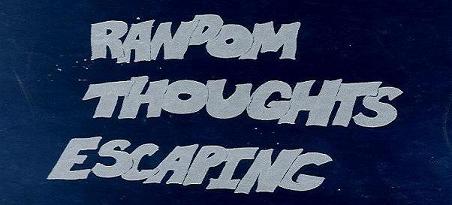
by 11 paper that came from I don’t know where. My weapon of choice was a fine tipped Sharpie. I had a manila folder that I had scrawled “Random Thoughts Escaping” across the cover (the masthead of this blog is a scan of that original folder turned into a negative). My first angst-y poetry collection. I wrote about all the things that were going on in my life, but primarily about the loss of love filtered through the dark and droning aesthetic of Disintegration.
Opening with the simultaneously crashing and swirling “Plainsong”, every last song on Disintegration is a masterpiece, epic in scope and often in length. From “Pictures of You” to “Last Dance” to “Prayers for Rain” to the thematically anachronistic “Lovesong” to “The Same Deep Water as You”, there isn’t a single song among the twelve that I wouldn’t consider brilliant, but “Closedown” and “Untitled” have always stood out for me.

The liner notes on the original album say “THIS
MUSIC HAS BEEN MIXED TO BE PLAYED LOUD SO TURN IT UP,” and the opening tribal drums of “Closedown” are relentless. You feel them thrumming in your chest with urgency at any volume. The immediacy of those four minutes of music – one of the shortest songs on the album – is underscored with a mere 11 lines of lyrics compacted into 40 seconds of song, making every turn of phrase, every word matter. The lyrics are well within lead singer Robert Smith’s doom and gloom wheelhouse, but the music feels uncharacteristically hard. While Cure songs of the era are typically dense, “Closedown” actually seems to apply pressure, actively pushing the air out of the listener’s lungs, suffocating them.

The final track is by far my favorite of the album. To my young man’s sensibilities, it seemed so brazen to not name the song at all and simply refer to it as “Untitled”. Four short verses. No chorus to speak of. “Untitled” never meanders but isn’t too terribly fond of rigid song structure either. The words Smith crafts matched the then-fresh emotional wreckage of my ended relationship. With the exception of Cowboy Junkies’ “Dreaming My Dreams With You”, no other song completely encapsulates that feeling of loss I was experiencing the summer before college when my girlfriend and muse left me. I leaned on this album, and “Untitled”, in particular, to fuel my fevered scribblings.


My dad was a meat cutter for a local grocery store and worked horrible hours, either getting up at four in the morning or working the closing late shift. My parents and I were barely speaking at the time – they didn’t understand what I was going through, and I was an unyielding 18-year-old – but on those early morning days, we’d often pass on the stairs, both of us bleary-eyed as one was heading to bed and the other heading to work.

The Cure didn’t come to Northeast Ohio behind Disintegration until just after I had moved on to Bowling Green for college, but I ended up being able to come home for the Prayer Tour stop at the Richfield Coliseum in late August. I had worked at a local record store in high school and the summer before college, continuing there on breaks from school. I attended the Cure show with Jen and Nancy (who drove across the state to pick me up), along with my record store boss Ron and part-time co-worker Randy, whose full-time job was box office manager of the Coliseum. Thanks to him, we had front row, center floor seats, but it would have been an amazing show even if I’d had to watch from the rafters. The only downside was that although The Cure had The Pixies and Love and Rockets – two bands I love – opening for them on their west coast swing, we ended up with Shelleyan Orphan.

Although I was moving on from the muse in San Francisco, the powerful connection between this album and those events wreaked havoc in me that night. I remember tearing up during “Untitled”, thrilled that they were playing such a deep album cut so important to me. It was a crazy night, and I remember being deposited afterwards in my dorm room on the other side of the state somewhat more worse for the wear, to be honest. I never saw The Cure live again.


The Cure never released another album as good as Disintegration. Wish swung far too much in the opposite direction, and the schizophrenic Wild Mood Swings was aptly named. The lone bright spot was the single “Wrong Number” off Galore, which hinted at late ’90s relevance.

Ten years after Disintegration, in an attempt to link a new album to the glory days, Smith stated 2000’s Bloodflowers was the final part of a retrofitted trilogy that includes the band’s brilliant works of Pornography and Disintegration. Regardless of the manufactured trilogy concept, Bloodflowers was a return to form and hit me as I was turning 30 and returning to Ohio after a decade away. Succumbing to waves of nostalgia, I gave it a pass.


The Cure faded from relevance for good after that, both for me personally and, apparently, commercially with releases of The Cure and 4:13 Dream. I still love the old albums and listen to them regularly. I can reliably queue up a Cure playlist and enjoy the music for what it is, but Disintegration I can also appreciate as an aural marker for some of the messiest stumbles along my path to young adulthood. Without regret.

Thursday, January 28, 2010

The End of the Eighties, Track 04

“A Few Hours After This…”
The Cure
In Between Days 12” B-side
1985

In the mid-’80s, John had this cassette tape called Standing on a Beach floating around in his car. At the time I was very much not into alternative music. I remember (primarily because he won’t let me forget) giving him a hard time for listening to that crap.

Fast-forward a couple of years and I’m buying that tape off of him for nine bucks.


Long after I picked up the CD version of the album, Staring at the Sea, I still played the hell out of that tape. Side one had all the singles, but side two had something the CD didn’t: “A Few Hours After This…”


I have referred to those two-and-a-half minutes as “the greatest b-side ever released,” and I stand by it. This song soars somewhere between the luxuriant Goth of Faith’s “The Funeral Party” and the pop sensibilities of Kiss Me Kiss Me Kiss Me’s “Just Like Heaven”. It’s the kind of song where I just close my eyes and arms are folded around me – safe, warm, lush.


In the liner notes of the Join the Dots b-sides and rarities collection, Cure frontman Robert Smith refers to “A Few Hours After This...” as “a slightly deranged experiment, an attempt to do something orchestral and quirky,” and that’s exactly how it unfolds. The music is majestic, all swirling strings and bold percussion, and mixing it with idiosyncratic love song lyrics multiplies its richness. Throwing in a splash of humor, something often overlooked when it comes to Smith’s work, in this setting is nothing short of peculiar brilliance: “A few hours after this and we're apart again / Like two white checks / Like opposite poles / In a secret game / (Like nothing like these I suppose...)”

Fifteen years later, the honest-to-goodness, number one, main reason I bought Join the Dots was to finally have “A Few Hours After This...” on CD. And, frankly, it was worth every penny. I remember bringing the set home and immediately popping disc one in the stereo, queuing up the song, cranking up the volume, settling into the couch, pressing play, and closing my eyes. Tracy flew downstairs as soon as the first chest-thrumming note hit, wanting to know why the house was shaking. I didn’t have a great answer for her; I could only explain that I had never heard this song so crisp and clear and needed the moment.

A couple years later, I was asked to review the third wave of Cure deluxe edition reissues for PopMatters. Among them were the expanded The Head on the Door remaster and the Rarities (1984-1985) disc, including a studio demo version of the song. It’s an expanded mash-up of what would become the lyrics to “Screw” and “A Few Hours After This...” on top of a guitar-based rendering of the composition, making it a fascinating window into how the two songs evolved.


That freshman year at Bowling Green was a lot of things, but, apart from being a song by a core group that helped define the era for me, “A Few Hours After This...” sort of encapsulates it all at its heart... over-the-top, playful, dramatic, quirky.